
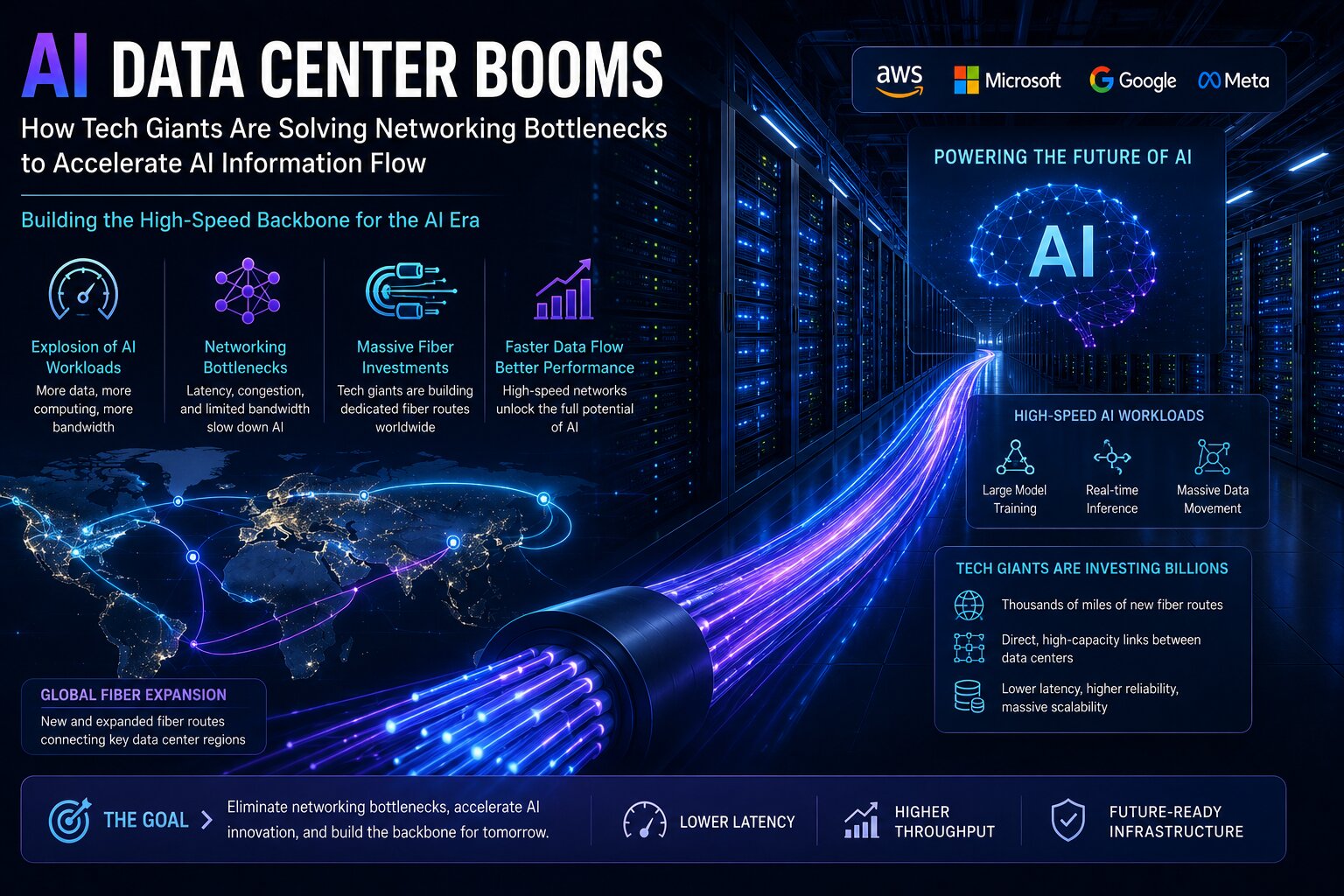
AI Data Center Booms: How Tech Giants Are Solving Networking Bottlenecks for the AI Era
Introduction
Artificial intelligence is driving one of the largest infrastructure transformations in modern technology history. As generative AI, large language models, and autonomous AI systems continue to expand, traditional data center architectures are struggling to keep up with the massive volume of data that needs to move between servers, GPUs, storage systems, and cloud environments. To address these challenges, technology giants such as Amazon, Microsoft, Google, and Meta are investing billions of dollars into advanced networking infrastructure and dedicated fiber routes. Organizations implementing cloud infrastructure best practices are increasingly focusing on network optimization as a critical component of AI success. In this article, we explore how AI is reshaping data center design, the networking bottlenecks slowing progress, and the massive investments being made to accelerate data movement across AI ecosystems.
Why AI Is Driving a Global Data Center Boom
The rapid growth of AI applications has significantly increased demand for computing resources. Training large AI models requires thousands of GPUs working together across distributed systems. These workloads consume enormous amounts of bandwidth and generate massive data transfers, forcing companies to expand and modernize their data center infrastructure.
The Hidden Challenge: Networking Bottlenecks in AI Infrastructure
While GPUs often receive most of the attention, networking has become one of the biggest bottlenecks in AI systems. AI training requires continuous communication between computing nodes, and even minor network delays can significantly impact performance. As model sizes increase, efficient data movement becomes just as important as raw processing power.
How Amazon and Other Tech Giants Are Solving the Problem
Amazon Web Services (AWS), Microsoft Azure, Google Cloud, and Meta are redesigning their infrastructure to support AI workloads at scale. These companies are building custom networking hardware, high-speed optical connections, and advanced switching technologies to reduce latency and improve throughput. Businesses leveraging digital transformation services can learn valuable lessons from these large-scale infrastructure strategies.
The Massive Investment in Dedicated Fiber Networks
One of the most significant trends in AI infrastructure is the expansion of dedicated fiber routes. Tech giants are investing heavily in terrestrial and subsea fiber-optic networks to ensure faster, more reliable data transmission. These networks create direct high-capacity connections between data centers, reducing latency and supporting the enormous bandwidth requirements of AI workloads.
Why Fiber Infrastructure Matters for AI
AI models process vast datasets across multiple locations. High-capacity fiber networks enable rapid communication between GPU clusters, storage systems, and cloud services. Without sufficient network bandwidth, expensive AI hardware can remain underutilized, leading to performance bottlenecks and increased operational costs.
The Rise of Optical Networking and High-Speed Interconnects
Modern AI data centers increasingly rely on optical networking technologies. High-speed interconnects capable of supporting hundreds of gigabits per second are becoming standard. These technologies help reduce latency, improve scalability, and ensure efficient data transfer between AI clusters.
What This Means for Businesses Adopting AI
As AI adoption accelerates, businesses must understand that successful AI implementation depends on more than just algorithms. Infrastructure, networking, and scalability play equally important roles. Organizations working with AI software development companies should evaluate their networking capabilities when planning AI initiatives.
The Future of AI Infrastructure
The next generation of AI infrastructure will focus on faster interconnects, distributed computing, edge AI deployment, and intelligent workload management. Investments in networking will continue to grow as companies race to support increasingly sophisticated AI models and applications.
How Organizations Can Prepare for the AI Infrastructure Era
Businesses should assess their network readiness, cloud architecture, and data management strategies. Partnering with experts in bespoke solutions can help organizations design scalable AI environments capable of supporting future growth and innovation.
Conclusion
The AI revolution is not just about smarter algorithms—it is also about faster, more efficient infrastructure. As AI workloads continue to grow, networking bottlenecks have emerged as one of the biggest challenges facing data centers. Through massive investments in fiber networks, optical interconnects, and next-generation networking technologies, tech giants are building the foundation required for the future of artificial intelligence. Businesses that understand and prepare for these infrastructure demands today will be better positioned to compete in tomorrow’s AI-driven economy.