
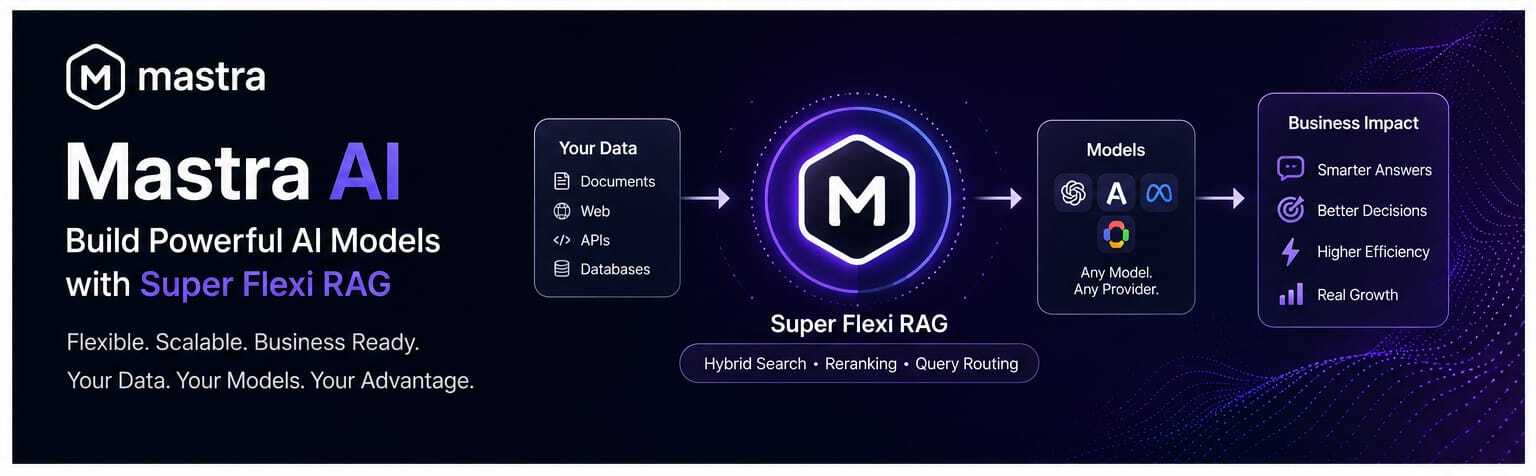
What is Mastra? The TypeScript AI Framework Transforming AI Agent Development in 2026
Introduction
Artificial intelligence development is evolving rapidly, and frameworks designed specifically for AI agents are becoming essential. One framework gaining massive attention in 2026 is Mastra—a TypeScript-first AI framework built for creating autonomous AI agents, workflows, and intelligent applications. As businesses increasingly rely on AI software development companies to build scalable AI systems, tools like Mastra are simplifying the process of developing production-ready AI applications. In this blog, we explore what Mastra is, how it works, its key features, use cases, and why it is becoming popular among developers and enterprises.
What is Mastra?
Mastra is an open-source TypeScript framework designed for building AI agents, workflows, and AI-powered applications. It helps developers create autonomous AI systems capable of reasoning, memory management, workflow execution, and tool integration. Unlike traditional AI frameworks focused mainly on experimentation, Mastra is built with production-ready AI deployment in mind.
Why Mastra Is Gaining Popularity in 2026
Mastra is becoming popular because it combines AI agent orchestration, workflow automation, memory handling, and observability into a single framework. Developers working with modern JavaScript and TypeScript ecosystems find Mastra easier to integrate into existing applications compared to Python-heavy AI frameworks.
Key Features of Mastra
Mastra offers several powerful features including AI agents, workflow orchestration, memory systems, Retrieval-Augmented Generation (RAG), observability, and multi-model support. Businesses adopting AI automation can use Mastra to build scalable and intelligent AI-driven workflows.
How Mastra Works
Mastra works by enabling developers to define AI agents, workflows, memory, and integrations using TypeScript. AI agents can interact with APIs, databases, tools, and enterprise systems while executing tasks autonomously. Its modular architecture allows developers to build flexible AI systems tailored to business requirements.
Mastra vs LangChain: What’s the Difference?
While LangChain is widely used in the AI ecosystem, Mastra focuses heavily on TypeScript-native development and production workflows. Mastra offers a cleaner developer experience for JavaScript ecosystems, making it attractive for modern web and SaaS applications. Organizations leveraging web development frameworks can integrate Mastra more efficiently into their platforms.
Business Use Cases of Mastra
Mastra can be used to build AI customer support systems, autonomous AI employees, sales automation agents, AI coding assistants, workflow automation platforms, and enterprise AI applications. Companies adopting digital transformation services are increasingly exploring AI frameworks like Mastra to automate complex business processes.
Benefits of Mastra for Developers
Mastra simplifies AI application development by offering reusable workflows, built-in observability, memory management, and easy integration with modern frameworks. Developers can rapidly move from prototype to production while maintaining scalability and reliability.
Security and Scalability Considerations
As AI systems become more autonomous, security and scalability are critical. Businesses implementing AI frameworks should follow cloud infrastructure best practices to ensure secure deployment, monitoring, and performance optimization.
The Future of AI Frameworks Like Mastra
The future of AI development will focus heavily on autonomous agents, intelligent workflows, and enterprise AI systems. Frameworks like Mastra are expected to play a key role in simplifying AI development and enabling businesses to deploy scalable AI solutions faster.
Conclusion
Mastra is emerging as one of the most powerful TypeScript frameworks for AI agent development in 2026. By combining AI orchestration, workflows, memory, and scalability into a single ecosystem, Mastra is helping developers and businesses build intelligent applications more efficiently. As AI adoption continues to grow, frameworks like Mastra will become essential for creating secure, scalable, and production-ready AI systems.